|
Deogarh:
On the trail of Shiva
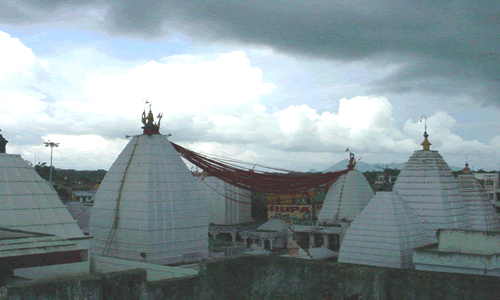
Deogarh is completely oranged in July and August. The entire town would be
swathed in this amalgamation of red and yellow, all other colors vanquished by
the color orange that lakhs of pilgrims wear while trekking the 80-mile stretch
from Sultanganj to Deogarh, to pay obeisance to Lord Shiva, his jyotirlinga.
Renowned
sarod player Biswajit Roy Choudhry remembers Deoghar, his little village
If you are reading this, you
probably have surrogate wings and are flying amidst the puffed, white candy-flossed
clouds. Perhaps it is July. And mercifully it must be raining - little drops slanting
on the bone-dry earth. You are probably sipping a chilled drink and chewing over
your job, life or a dream. Do something different.
Walk up to the pilot and ask him if he would be a tad generous today and fly you
over Deogarh, a district headquarter in Jharkhand. Ask him. In all probability,
he won't. Tell him Deogarh is completely oranged in July and August. The ground
beneath the aircraft's belly would look strikingly gorgeous - the entire town
would be swathed in this amalgamation of red and yellow, all other colors vanquished
by the color orange that lakhs of pilgrims wear while trekking the 80-mile stretch
from Sultanganj to Deogarh, to pay obeisance to Lord Shiva, his jyotirlinga. Deogarh,
which literally means Home of the Gods, is a slight aberration in defining its
religious tenor. It actually owes it to Ravana, the demon king, who, in Hindu
mythology, is always synonymous with Evil.
According to Padma Purana,
Ravana, the king of Lanka, propitiated Lord Shiva through his penance at Mount
Kailash and an appeased Shiva rewarded him with a lingam that he could carry to
his kingdom. The munificence came with a decree though - the lingam could not
be kept on the ground, if Ravana failed to heed to this, the lingam would dwell
forever wherever it touched the ground. The bounty ruffled
feathers in the neighbourhood where all the gods lived. They conspired to foil
Ravana's attempt to take the lingam to Lanka. According to mythology, on his way
from Mount Kailash to Lanka, Ravana stopped in a dense jungle to relieve himself,
handing the custody of the lingam to a shepherd. But Ravana took too long to answer
Nature's call (remember the Gods were conspiring!) and the bushed shepherd left
the lingam and moved to tend to his flock. Lord Shiva's
decree was breached and the lingam dwelled forever in that dense forest, in what
is now known as Deogarh. A disconsolate Ravana went back to his kingdom but came
every day to offer obeisance to his deity. It is said that after Ravana's death,
the lingam fell into complete disarray, until it was discovered by Baijju another
shepherd, hence the name Baijanath Dham. Though Deogarh
is on the itinerary of every Hindu pilgrim, it is during the month of Shrawan
(July- August) that the town acquires its full religious fervour.
Pilgrims
from all over the country, some even from the neighbouring Nepal and Bangladesh,
pick up water from the Ganges at Sultanganj (it is the only point in its meandering
route that the Ganges flows North) and walk barefoot for 80 miles to offer the
holy water on the lingam of Shiva. They all wear orange, they all chant BolBam
and they never let the holy water touch the ground. They carry the water in the
kanwar (pots tied to two ends of the stick) and the pilgrims are therefore referred
to as kanwarias. Although all of Shrawan is considered
auspicious for the worship of Lord Shiva, the five Mondays that fall within the
Shrawan month are specially propitious. Every Monday, more then 15 lakh devotees
throng the temple, which, it is said, was constructed by Lord Vishwakarma out
of a single piece of rock. The 72-ft main temple, built
in the Nagra style of architecture, is noted for its panchshula, unlike a trishul
(trident), Lord Shiva's usual accoutrement. Lord Rama, who, it is said, picked
up water from the Ganges in Sultanganj and offered it to the lingam in Babadham,
started this tradition. Though Deogarh is primarily about
the main Shiva temple, there are 22 temples within the holy precincts dedicated
to various gods of the Hindu pantheon. But there is much more to this district
headquarters than Shiva and his consort, Parvati. The
Satsang Ashram set up by Thakur Anukul Chandra, was one of the prime reasons for
a large number of Bengalis to leave the grime of Calcutta and settle in Deogarh.
Even today, more than five lakh devotees visit the Ashram during the annual celebrations.
Another attraction is the Navlakha Temple, which is similar
in architecture to the Ramakrishna Mission Temple in Belur. The temple, dedicated
to Radha and Krishna, was built at the cost of Rs 9 lakhs, hence the name Navlakha
Temple.
According to legend, Rani Charushila who belonged to the royal family
of Pathuria Ghat, Kolkata, became a widow at an early age and also lost her son.
The aggrieved queen left home and later met Saint Balananda Brahmchari, on whose
advice she got this temple constructed.
The touristy kinds always set
aside time to enjoy the beauty, specially the seunset and sunrise at Trikut Pahar
and the Nandan Pahar. We were talking about Deogarh, but
what happened to your request?
Probably the pilot did not listen to you,
this plane did not fly over Deogarh. Do something different someday. Rent a helicopter
and twirl over this holy city. You would be rushed off your feet by the bellow
of Bol Bam and the verve of the color orange. Perhaps it happened to avid travelers
Megasthenes and Huen Tsang also. It is no shocker then that they both mention
Baidyanath Dham in their celebrated treatises on India.
Published
in Swagat, Indian Airlines in-flight magazine, July 2004. |