|
Deoghar
& Parasnath: Abode of the Gods
If Deoghar makes for a great walking experience, Parasnath
is a great trekking tale. Perched at a height of 4,480 ft. it was on Mount Parasnath
that 20 of the 24 Jain Tirthankars attained salvation. And it is for this reason
that the Jains swarm to this dusty town, where there are perhaps more temples
and dharamshalas than its permanent residents. A twirl of the head, a slant of
the eye, a tiny footstep forward and you are accosted by another temple to admire
or pay obeisance.
Never
before in mythology was a demon blessed with a largesse so bountiful that even
the neighboring gods twitched in envy. Never before was Nature's call such a killjoy
and Fate such a curmudgeon. And it is in these 'never-befores' that the history
of Deoghar unfolded in an age when the gods and the demons not only conversed
but also indulged in conspiracies and skirmishes. Appeased
by Ravana's prayers and piety Lord Shiva allowed the Lankan king to take the jyotirlingam
to his kingdom. But with generosity came a caveat - the lingam should not touch
the ground, if it did, it would dwell there eternally. But
Ravana knew not that it was the gods who were conspiring and that they had a robust
clout. Lord Indra, the rain-god, was lined up for the job and the bane came in
the form of a full bladder. As the story goes, Ravana handed over the lingam to
a shepherd and went into the dense forest to relieve himself. But when he took
too long the decoy shepherd (it was Lord Vishnu) abandoned the lingam and the
neighborhood gods sounded the victory bugle. The gods and Nature's call threw
a wet blanket on Ravana's dreams but it gave Deoghar its presiding deity and its
eminence. Mentioned in the
Puranas and Megasthenes' travelogues, Deoghar is skirted by beautiful hillocks
and its waters are said to contain the panacea for all stomach ailments. The town
seems to have been built imprudently, there is no method to its topography nor
to its settlements, everything seems to have rooted itself wherever it found enough
legroom. The everyday Deoghar
is pious, yet ordinary. People from all over the country offer prayers in the
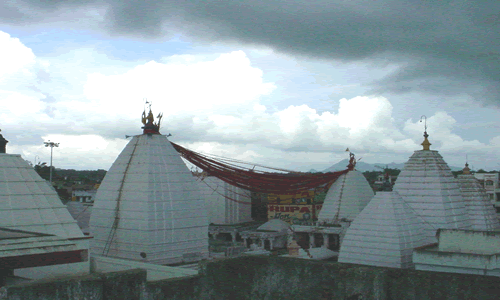
22 temples that comprise the Baidyanath Dham complex and several others on the
town's fringes, but that glitz is missing. It is during Shrawan (July-August)
that the town showcases its splendor. The entire month Deoghar is dressed in orange,
the bells chime perennially, the chant of Bol Bam wafts in the air and it is so
crowded that all you get is an elbow space to squeeze through. And yes, who would
forget the sweet fragrance of the khoya pedas that get made only in this patch
of the earth. Nowhere does one color so completely vanquish its brethren; to an
outsider it would look as if the entire town had been dipped in a cauldron spilling
with the orange dye. It looks incredibly handsome! And
all those who come here follow a rigid ritual - they pick up water from the Ganges
in Sultanganj, walk 109 kms barefoot and then offer their prayers in the main
Shiva Temple. It usually rains during this month, the long trek is arduous but
if nearly 50 lakh people do this annually there has to be something about the
kamnalingam, the only one in the country. Though
Lord Shiva rules the roost, Deoghar is a little more than this god of destruction.
The sunset at Trikut hill is stunning, the park at Nandan Pahar is a must-see,
there's the gorgeous Navlakha Temple (it took Rs 9 lakhs to build this temple,
hence the name Navlakha), the Ashram of Thakur Anukul Chandra, the Ramakrishna
Mission and of course, the Boot House. The town might still be waiting impatiently
for traffic lights but every possible comfort is available to the tourist. If
Deoghar makes for a great walking experience, Parasnath is a great trekking tale.
Perched at a height of 4,480 ft. it was on Mount Parasnath that 20 of the 24 Jain
Tirthankars attained salvation. And it is for this reason that the Jains swarm
to this dusty town, where there are perhaps more temples and dharamshalas than
its permanent residents. A twirl of the head, a slant of the eye, a tiny footstep
forward and you are accosted by another temple to admire or pay obeisance. They
are in exquisite marble, in mundane red bricks, some elegant, others unkempt,
some colossal, others just rising above the ordinary. And the temple complex is
not prejudiced, for it welcomes both the Digambars (space-clad, or naked) and
the Svetambaras (wearers of white cloth). Before
you pack your sneakers for the trek, glance at the facts. Roughly 4,480 ft. might
not look that daunting till you hear it in kms. - it is 9 kms uphill and the incline
is truly unreasonable. The walk around the Sammed Shikar is another 9 kms, add
to it the descent distance. That's a total of 27 kms - just a tad more than the
marathon. It is a five-hour trip, including the return journey and a look at the
two temples and 24 shrines. Don't
let the facts dishearten you and don't start pulling that favorite sneakers out
of the bag. Not yet, there's help. You can be carried up the mountain for a price;
the price depending on how much lard you have accumulated over the years. You
can squat or sit cross-legged in a doli (small woven cots) and be ferried by two
men. But before that they talk business. There are no weighing machines around,
they look at you and quote - a 60-odd kgs could be carried for Rs 550. Don't haggle,
it thaws nothing. If you don't want your calf to cry in pain, part with that cash,
it is worth it.
P.S.: In your religious fervor don't get swayed by the
umpteen herb-hawkers that blotch the mud-spattered lanes. They promise the moon
- and the local viagra - but hold on to your common sense. Or, else you might
really need the gods for your next breath. Published
in India Today Travel Plus, September 2004. 
|