|
About
Lady's Slipper & Pygmy Lily
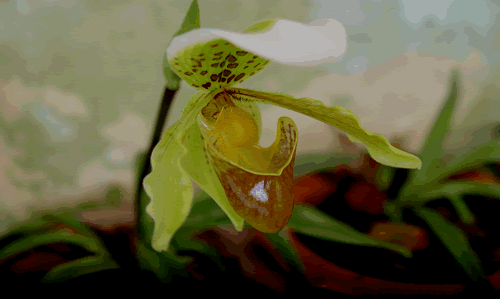
Photograph
by Preeti Verma Lal
There are 300 different species of orchids,
their names ranging from a high-heeled 'Lady's Slipper' to the tangy 'Wild Citrus'
and the not so tall 'Pygmy Lily'; their colors from the white of ivory, to the
russet of a potato, the yellow of a canary, the blue of Paul Newman's eyes; their
shapes so distinct and unique that it would be unfair to tell their tale in words.
Look at the formation of Lady's Slipper, also known as moccasin flower, and you
would know what exclusive means. One look and you might get tempted to slip your
feet into the dainty slippers..
If
you have ever strolled in London's Royal Botanic Garden, better known as the Kew
Gardens, and been mesmerized by the utterly exquisite Blue Vanda orchid there,
you must thank Sir Joseph Hooker, the renowned British botanist. It was he who
took the Blue Vanda from Meghalaya's Jaintia Hills to propagate it in the Kew
Gardens. The Vandas have been spreading their splendor in London for more than
a century now, but this is just one aside when one talks of the orchids of Meghalaya.
The tiny North Eastern state can happily be called
an orchid country, and it is not surprising that orchids are the mascot for Meghalaya
Tourism. In the sprawling forestlands, gardens and nurseries of this state grow
nearly 300 species of orchids, their names ranging from a high-heeled 'Lady's
Slipper' to the tangy 'Wild Citrus' and the not so tall 'Pygmy Lily'; their colors
from the white of ivory, to the russet of a potato, the yellow of a canary, the
blue of Paul Newman's eyes; their shapes so distinct and unique that it would
be unfair to tell their tale in words. Look at the formation of Lady's Slipper,
also known as moccasin flower, and you would know what exclusive means. One look
and you might get tempted to slip your feet into the dainty slippers (in actuality
the orchid's labellum). When you roam around the hills
of Meghalaya, you would feel that the gods were really generous when they sculpted
Meghalaya out of their imagination, they not only gave them orchids, but added
that rare insectivorous Pitcher plant also. Belonging to the dicot family, the
Pitcher Plants have entire leaves moulded into tubular and hollow pitchers that
are lined with downward-pointing hair. When an insect falls into the trap it cannot
clamber up because of the hair, falls into the pit of the tubular leaf and is
digested by the juices. Orchids are found everywhere
in Meghalaya, in shops, in daily markets, in offices, in homes, but if you really
want to see them in their natural habitat go to the forests of Mawsmai and Mawmluh,
the two proud of hosting the highest number of orchid species in the entire region.
If you are on your way to Cherrapunjee, don't forget to stop at Sohrarim forest
for another great dekko.
The orchids are fast becoming a flower lover's
delight and the orchids from Meghalaya have found takers in several countries
including Sikkim, Bhutan, Nepal, China, Burma, Malaya, Thailand, to name a few.
This demand is also endangering the orchids that are now becoming fast money-spinners
for a lot of people; some of the ornamental species and those growing exclusively
in Meghalaya (nearly 1,250 species are found in India) are on the verge of extinction.
Naturalists and environmentalists are now pulling their socks up to preserve this
blessing of Nature, they think there is an immediate need to set up orchid sanctuaries
and orchid banks all over.
When in Meghalaya don't just gaze at the orchids
wide-eyed, say a prayer for the longevity of these graceful and classy creations,
for if they are wiped out the world would be so prosaic and pedestrian to live
in.
Published
in Discover India magazine, December 2004. Contact:
Preeti@deepblueink.com 
|