|
Finding
life in the deserts of Rajasthan
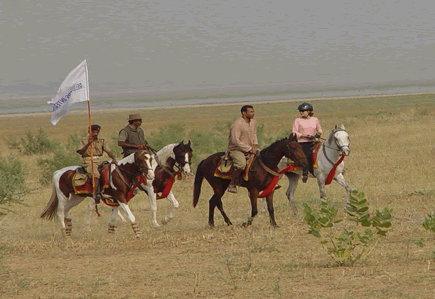
Photograph
by Preeti Verma Lal
I have trudged the world but never have
there been such exhilarating eight days - royalty, compassion, relief, friendship,
great food all stringed beautifully. Honestly, I would shove the jeep again, I
would not lament the death of my expensive Nike, I would happily live without
electricity if I could go traverse the desert again with the Relief Riders.
Have
you ever pushed a jeep off the bolshie sand dune and allowed the sleek sand to
caress your skin casually? Have you ever gaily tied the floundering sole of your
Nike with long dry grass? Or, have you ever sat on a camel-cart, barely 12 inches
away from the unkempt animal and heard the rumble from its rear? Do you know what
it is to get lost in the middle of nowhere and hitchhike with three menacing-looking
men? Have you ever sat on a knoll and let the moon read your journal and the hoopoe
hear you sing? Have you ever rediscovered Life this way?
I did. I
met Life again in the deserts of Rajasthan, as I traveled on camel carts and open
jeep for eight days with the Relief Riders (www.reliefridersinternational). Perhaps
there was a reason to it for even the beginnings of the ride were rather quirky.
I was lazing in the backwaters of Jharkhand, an eastern Indian state, and one
night while surfing the Net stumbled upon the profile of a man who had done special
effects for The Matrix and X-Men and was now organizing an enchanting 15-day combo
of adventure travel and relief. I read the name: Alexander Souri. Before sending
an email I hurriedly built an image of the Hollywood man - long, salty hair, in
beret and moccasins, crow's feet, a long drawl. He replied, we met and 10 days
later I was at the Imperial Hotel in New Delhi getting introduced to the other
riders: a French photographer, a studious American lawyer, a former French army
commando, a perky interior decorator from New York, an ayurveda doctor from Kovalam
and Souri, the Relief Riders International founder-director, of course without
any salt in his hair, no crow's feet, no beret… On
that nippy morning in the porch of Imperial Hotel, bags were counted and dumped
in the boot of a mini bus and we set off for Mukundgarh Fort, some 200 kms off
Jaipur. It was a lingering, crinkly ride and as the travelers got sloshed with
the images of India, I sat behind the chauffeur and worked as an interpreter of
some measure, he spoke a dialect that nobody understood and I stretched my imagination
to decipher the banter. On way there were curious onlookers,
a delicious lunch, some soggy bananas and little friendships furrowing their way
through smiles, laughter and stories. At the end of six hours when we jumped out
of the bus at the sprawling Mukundgarh Fort, there were no strangers: Alice Read
wanted a quick Hindi lesson, Karen Cedar asked for chai at the dhaba, Laurent
Millet loved the paranthas and Souri rehearsed his Hindi and reminisced about
his days in Sherwood College. Mukundgarh is dusty and
so full of stunning frescoes that the brown of the streets looks anomalous. The
fort is nearly 200 years old and when the sun went down the elm we roamed its
stable. There they were, the Marwari horses, their color honey, amber and snow,
they sturdy, taut and proud of their fifth gait, the 'revaal'. The riders picked
their horses, got into a friendly conversation for we - men, women, horses, camels,
cooks, grooms, attendants - were all to trudge through an assortment of villages
in Rajasthan for the next 15 days. The itinerary was different from any other
I had seen or travelled before - we were to rest the nights at forts and mansions,
tents and even dharamshalas (lodging facilities for pilgrims); the ride would
include participation in medical camps in unknown, uncared for villages, distribution
of livestock along the way and providing educational materials to students in
a village school. The next morning I was riddled with
choices - I could travel to Khirod village on the back of an open jeep or hop
into a camel cart. I looked at the russet camels munching to glory and twinkled
at a new experience. Camel it would be, I proclaimed trying to jump into the cart.
But before I could complete the sentence I slid to the ground, the cart was too
high for the diminutive me. It was a mirthful moment and when I could not make
it even the second time, I had to be literally pulled into the cart by the French
photographer. That was just the beginning of the ride. Khirod
is just 21 miles away but when on a camel cart and winding through mud roads flanked
by prickly shrubs and hastily built mounds, destination can be as far as eternity.
At least it was that afternoon, when after having counted the slow pace of the
camel and picking fragrant flowers on way, we strayed some 20 kms from the lunch
spot and were parked in the wrong village. Famished and bewildered at having gone
astray I knocked the local houses hoping there would be a phone connection. There
weren't any. I flagged down a jeep and pestered the menacing looking men to take
me to the nearest phone booth. They did and after several SOSs the rescue vehicle
arrived and drove us to the lunch spot - an orchard near which nomads were pitching
their lives again. Hours later when the moon rolled onto
the sky, the temperature rushed down so quickly that I had to cower and wrap the
dupatta tight around myself. There was silence all along the rest of the ride
and when we reached the campground I could recognize the newfound friends in the
ochre of the burning logs. Not too far under a canopy food was being cooked, water
was being boiled in colossal copper pots for hot shower and the tents were pitched
in beautiful symmetry. There was no electricity and the cell phones were dead
and how I loved that idleness of technology. Nearly 25
miles on a camel cart each day can be quite a drag, so one day I opted to travel
in the open jeep. If you can tell a story between two paces of a camel, riding
in an open jeep in a desert could be fast and furious. My hair flew, the entire
stretch became a tanning bed, the sand scuffed the skin and the prickly shrub
stabbed my forehead and I bled. But that was just the aperitif, our goose was
yet to be cooked. It did when the jeep got stuck in the sand. The stubborn sand
would not loosen its vise like grip, we pushed, the vehicle growled but did not
move. We beckoned two villagers and after a lot of loud breaths and twitched backs
the jeep moved, we hopped back and waited for the riders. But
that was not just once, the jeep got stuck five times in the 120 miles that we
travelled and every time I was part of the push. Talk of being unfortunate in
an arid land! There were scary moments too - in Kochor the sandstorm nearly blew
our tents away while some marauding blue bulls roamed in the vicinity. In that
hamlet there was some semblance of technology too. In the land hemmed with mountains
and a lake, there was one modest spot where the city cell phones would catch the
signals. Three large rocks were immediately placed there and every time somebody
had to make a phone call they would walk to the rocky 'phone booth'. Seen any
better indigenous telecom arrangement? All along the 120
miles there was more to this ride than twitched backs, dead phones, and traditional
Rajasthani performances at night. There was royalty in the forts that we stayed
in, like Danta Fort that for 300 years has weathered history, intrigue, grandeur
and flamboyance within the confines of its burly walls. There were hand fans so
large that it must have taken 10 men to imitate a windy evening, skins of tigers
shot for pleasure and iron shields that kings used to protect their kingdoms,
halls so large that one could fit a baseball field and seat 10,000. If
royalty was sown in the itinerary, Souri also interspersed it with compassion.
There was relief at the medical camps where hundreds of people turned up when
the Relief Riders dispensed medicine and served food. In the school in Kochor,
the children played with their new toys and books gleefully and when Souri distributed
goats in Lohargal amongst families beyond poverty line, the old man cried and
the wrinkled woman blessed. I have trudged the world but
never have there been such exhilarating eight days - royalty, compassion, relief,
friendship, great food all stringed beautifully. Honestly, I would shove the jeep
again, I would not lament the death of my expensive Nike, I would happily live
without electricity if I could go traverse the desert again with the Relief Riders.
I am glad that this time when Life called, I rode.
Perhaps there was a reason. Perhaps it is Destiny.
Published
in India Currents, USA Contact:
Preeti@deepblueink.com 
|