|
Arranging
other people's happiness
Photograph
by Preeti Verma Lal
Forget happiness, you also missed the
fun - riding on honey-colored horses that had rumps like planets, staying like
Neanderthals in tents and behaving like royalty in ancient forts, you missed walking
barefoot on the silken sand to watch the ants plod, the spiders web an orb at
night and the cacti crack the earth, you missed picking marigolds and loofahs
from the wild, you would have loved the sumptuous meals and your jaw would have
fallen when the fire-eater ate, well, fire.
Let
the eulogies and the travelogue wait; let's begin with happiness and defiance.
No, I am no Nietzsche defying God, I just want to defy litterateur Graham Greene
who vociferously refutes that one man can arrange another's happiness. "No
one can arrange another's happiness": That's ripped straight out of the sepia
pages of The Heart of the Matter. Ah! Mr Greene, you stand corrected. Happiness
can be arranged. But how would you know? You missed travelling with Alexander
Souri and his Relief Riders in Rajasthan. You did not stroke the sweat on the
taut bodies of the Marwari horses, you did not hear the blessings that an old
wrinkled man whispered when Souri gave him goats for sustenance, the tears of
a doddering, nearly-blind woman who was treated at a medical camp in an unlamented
village did not fall on your grave Mr Greene, you ignored Souri's heartbeat when
a little, unkempt school kid gave him flowers and said a hushed 'thank you.' You
missed it all Mr Greene. Another person's happiness can be arranged. I saw Alexander
Souri do that. Just that you weren't there Mr Greene. Bad luck! Forget
happiness, you also missed the fun - riding on honey-colored horses that had rumps
like planets, staying like Neanderthals in tents and behaving like royalty in
ancient forts, you missed walking barefoot on the silken sand to watch the ants
plod, the spiders web an orb at night and the cacti crack the earth, you missed
picking marigolds and loofahs from the wild, you would have loved the sumptuous
meals and your jaw would have fallen when the fire-eater ate, well, fire. All
right, all right, there were scary moments too - when the marauding blue bulls
came too close to the lake where the tents were pitched, when the sandstorm nearly
blew our tents away and when the camel cart went wayward and I was stranded in
the middle of nowhere. That also happened. I twitched my back pushing the jeep
off the stubborn sand and when my expensive Nike broke its seams, I tied its flapping
sole with long dry grass. That also happened. I also heard the rumble from the
camel's rear - believe me, it is pretty raucous and smelly! It
all happened when I travelled with the Relief Riders (www.reliefridersinternational). It
all began with one man's dream, a man from Great Barrington, Massachusetts, who
has worked on the special effects of The Matrix and X-Men, has produced promotional
films in China and managed special events for Cannes, Sundance and Venice film
festivals. That man is called Alexander Souri, he is the founder-director of Relief
Riders International (RRI); he also has deep-set eyes and that rich baritone in
his voice. He had all the necessary glitter in life, but when his father died
he was rummaging his soul for answers, he wanted to give back, to pay a tribute
to his father and his country, India. And one day he found an alibi to repay heaven
for its blessings when he founded RRI and conceived of the unique adventure plus
relief combo, an itinerary not many have scrolled before. The
dream turned into a caper one October morning in the porch of New Delhi's Imperial
Hotel, when the autumn's yellow lay unfeigned, the sun was solicitous and bags
were tagged, counted and dumped in a small bus. Yes, there were the riders from
the US and France - a strapping horse-whisperer, a perky interior decorator, a
solemn lawyer, a groggy photographer, a sincere ayurveda doctor and stringing
the people and logistics was an indefatigable Souri. In between stood I in a red
dungaree trying to decipher and partake in the conversation that flowed in accented
English, French, Tamil, Hindi and the dialect of the chauffeur, the banter shifting
from Falabella horses, marriage, rowdy kids and the zen of motorcycle maintenance.
We were on our way to Mukundgarh, our first stop, some
200 miles away. On way images and colors flitted past - women with their heads
covered, curious men waving hurriedly, children carrying sunshine in their eyes,
the brown of the hillocks and the silver of the thorns. After six hours and several
villages we reached the 200-year Mukundgarh fort that has lime doors and turquoise
chandeliers. The burly, sunburned walls of the fort are laden with frescoes and
in the courtyard an old cannon sits like an old maid lamenting the lost grandeur.
In the evening, the riders checked their mounts in the stable that abuts the fort's
high walls. The ride began next morning, the horses saddled,
the riders in jodhpurs and boots, all slathered with sunscreen. Laurent Millet,
the French photographer, and I opted for the unkempt camels over the alluring
horses. The camel carts were stacked with relief supplies for the underprivileged
and there was just enough space to squeeze in. But who would have thought that
hopping into a camel cart would be such an arduous proposition. I put my right
foot on the wooden protuberance, slipped and nearly fell. Next time, the camel
wriggled and I was back on the ground. Another try: I put my foot on the wood
and Millet pulled me into the cart. I sure made a funny sight, but being petite
can have its riotous moments. The camel crawled and if
I had started to walk, I would have reached the destination much earlier. But
when you are on a camel cart trudging on mud roads slim as a twig, destination
can be elusive. The riders on horseback, the cooks in an open jeep and we in the
camel cart were supposed to meet in a tiny orchard some 20 kms away for lunch.
But lunch it was not to be, the mud road took us way off the destination. Millet
and I were lost in the middle of a village where there were no phone booths and
the cell phones lay dead. Standing on a crossroad I flagged down a vehicle and
requested three strangers wearing ear studs and looking menacing to take me to
the nearest phone booth. The phone was not working and I sat there on the wooden
bench looking greedily at the sweetmeats. After much effort
and several prayers to the phone, the rescue vehicle arrived and we just about
made for lunch in the tiny orchard. A hearty lunch and I was back on the camel
cart (well, I never give up, do I?) to another village where we were supposed
to camp in tents in an open desert. The moon shone, the owls howled, we could
hear our own heartbeats, the walkie talkie got cranky and we got lost again. The
camel cart rider ran to the nearest hut for directions, the walkie-talkie finally
beeped and we reached the camping ground where a bonfire lit the dark night. The
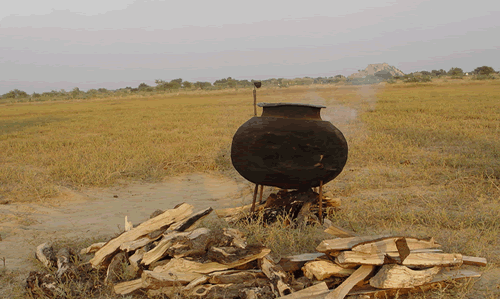
campsite looked stunning and it had all one could ask for: water being heated
in gigantic copper pots, food being cooked in a nearby tent, bottled water, bonfire
for warmth, soup for revival of spirits and a caravan with flush toilets. The
cell phones weren't working, there was no electricity but nobody whined. Alexis
Ruffat, the French army commando spun tales, Alice Read read Amy Tan, Karen Cedar
scribbled in her journal, Millet fiddled with his Hasselblad and Souri caressed
his favorite horse and smiled at the unfolding of his dreams. Each
day we travelled for around five-six hours from one village to another, the temperature
making the sartorial decisions: white in the mornings and light jackets at night.
In Khirod and Danta villages, hundreds of people turned up for free medical check
up and medicine, a largesse that the dusty village had not seen before. At a school
in Kochor village, children who received sports and educational goods played with
their new toys. On the map they looked for Massachusetts, the home of the man
who had flown thousands of miles to bring smile and sunshine into their lives.
For the Riders, it was an experience they had never lived before, though most
of them had seen poverty in the Third World countries. For Souri, it was his own
way of keeping hope alive in a time of war and geopolitical instability. I
spent eight days with the Relief Riders and got back home in a rickety bus. I
brought home some fragrant wild flowers that I had picked from the mud-spattered
roads, I carried the scar that an audacious thorn had etched on my forehead, I
gathered the sand from the hem of my skirt and put them in a porcelain urn. And
within the sepia-toned pages of The Heart of the Matter, I boldly stuck a handwritten
note. It read: One can arrange another person's happiness, Mr Greene. I saw Alexander
Souri do it in Rajasthan. Don't you wish you had traveled
with the Relief Riders, Mr Greene? Come, they will be in Rajasthan in February
and in the Himalayas in August. Just make a promise - rearrange your idea of happiness.
Published in www.e-marginalia.com Contact:
Preeti@deepblueink.com 
|