|
The essence of meal exchange is to address social issues: Rahul Raj
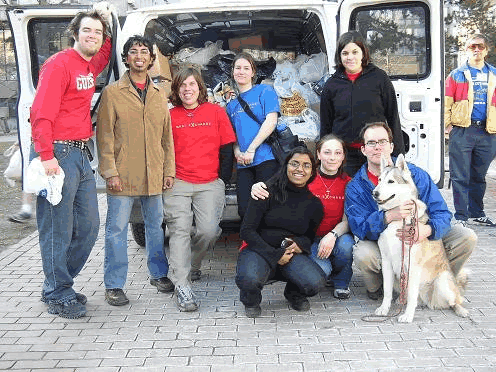
Rahul
Raj (second from left) with Meal Exchange volunteers Nearly
10 years ago, a 17-year old frugal eater joined a university in Canada. He could
neither eat all on the platter nor could he opt out of the one-mealsize-fits all
plan. That is when he thought of donating that extra morsel to the needy. That
thought gradually turned into a revolution that now has 50,000 Good Samaritans
in over 52 university campuses. So far, Rahul Raj's Meal Exchange program (www.mealexchange.com)
has facilitated the donation of over 260,000 meals (roughly $750,000 worth of
food) and is poised for a donation of over 200,000 meals ($500,000 worth of food)
this coming year.
It is not surprising then that Raj, who believes that
'giving must be a part of our daily routine and not only when it was convenient',
was picked by Time magazine as one of the social entrepreneurs who really matter.
The Alumni award, Business in Ethics Award, Governor General's leadership award
and Indo-Canada Chamber of Commerce Youth Achievement Award also sit proudly on
the mantelpiece. At 27, Raj considers his
grandmother and his grand uncle as his biggest inspirations, loves comedies and
suspense novels, takes public transport and sports an interesting soul patch.
On occasions he also questions his wisdom of leaving a cushy job at P & G
to nurture Meal Exchange, but hunger remains his pet peeve and he is doing all
he can to chase it out of the earth's precincts.
Time
magazine honored you with the 'social entrepreneur' and the 'young revolutionary'
tag. How would you describe what you are doing? A revolution? Entrepreneurship?
A combination. My role is somewhat simple. I listen to the brilliant
ideas emerging from youth and help bring the best social ideas into fruition.
Young people have a tremendous amount of potential that often goes unnoticed.
We listen. I listen. As a result, we tend to attract other believers and supporters
of youth. It is their efforts that have driven the revolution. People
the world over have tried to tackle hunger in different ways. Yours is an extremely
interesting idea, what started it all? The essence of
meal exchange is to encourage young people to address the social issues in their
community. In particular we have chosen hunger as it is the least polarizing and
most pervasive of social ills. Our programs are far from addressing the root cause
of hunger, but attempt to illustrate how simple and impactful helping can be.
What started it all was a meal plan that was ill suited to my appetite. I
am light eater and was forced to purchase a one-size-fits-all plan. I didn't think
this was fair. At the same time, I noticed that many of my peers had a genuine
desire to help but were uncertain how best to do so. Many also believed they had
nothing to give. The goal of the skip a meal program (the program that allows
students to donate money from their residence meal plans) was to show them that
there was always something they could give... And not just when it was convenient. What
was the response of your mates, family? You were barely 17 then, did they think
it was a passing fancy?
Completely. The idea was perceived as 'cute'.
And perhaps that was fair; who knew that I was going to keep with it. Did
you have any idea that it would swell to such a huge program, listing hundreds
of members and thousands of meals?
Not initially. But when I began
to see the program in action, I knew that I was on to something. It wasn't until
I was approaching my fourth and final year, that I realized meal exchange would
either prosper through my efforts, or falter through their absence. I convinced
a professor to support me in writing a thesis on creating a managing a non-profit
organization. It was through this process, that I affirmed the potential of meal
exchange and committed to seeing my plan to fruition. At
one point your coffers ran dry, your personal loan ran out, what lured you on?
Do you think meal exchange can now sustain itself and go on forever?
I
had to go on. I was in serious financial difficulty and would not accept failure.
I knew the idea was a solid one. My challenge was to convince others that it was
worth supporting (financially). Yes, I believe meal exchange can sustain itself.
Making this happen will certainly be challenging, but I am confident we will devise
a solution. The program is completely
Canada-centric, though you are inviting volunteers from the US. But hunger, stark
hunger, really lives in another part of the world - Somalia, Nigeria, Bangladesh,
amongst several others - how do you plan to reach out to them?
Yes,
the program to-date is Canada-centric, partially driven by convenience and partly
by necessity. Given that I live in Canada, I am more familiar with the culture,
infrastructure, politics and business climate, which makes it easier to realize
social change. That being said, I genuinely hope that over time, I am able to
mobilize the financial resources required to support students around the world
(particularly in countries where hunger is a more serious issue) in addressing
hunger in their own community, as it is they that know what works best, not an
outsider. I also wanted to test out this theory in Canada. If I could not help
address hunger in a geography that I was familiar with, I certainly couldn't do
it an unfamiliar country. Are you
planning chapters in India?
Yes, I hope so however it is dependent on
both the desire of students in India to work with us and our ability to mobilize
the resources required to support them. Any
message for those who want to walk the unbeaten path?
Walk steadfast
and remain humble.
Published
in Sun Magazine, December 2004
|